
What is Ironflow?
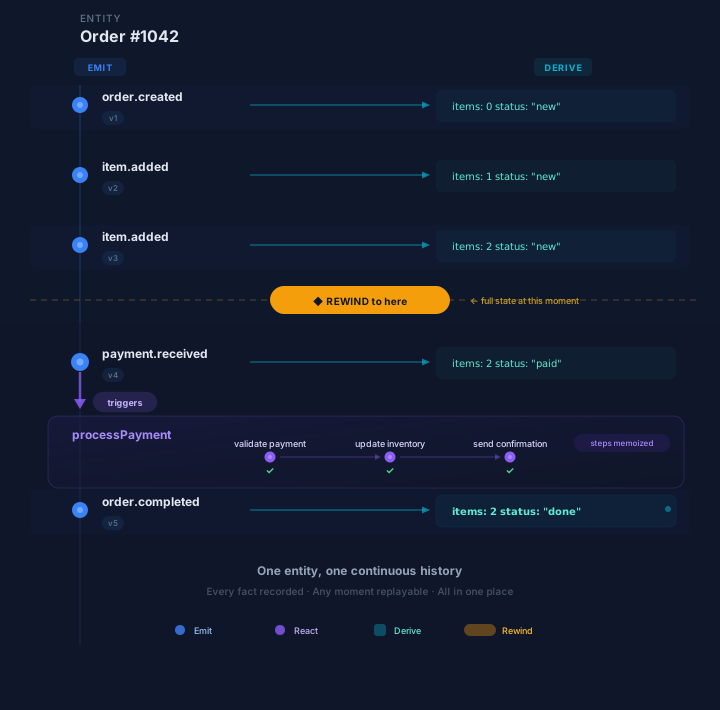
Ironflow is a Continuous History platform that ships as a single binary. Every event, every workflow step, every state change is recorded into one continuous history — and everything else is derived from it. Emit events from anywhere. React with recorded execution (durable workflows). Derive real-time views from your history. Rewind to any moment to debug, patch, or replay. Zero infrastructure to manage.
Why Ironflow?
Section titled “Why Ironflow?”Building reliable backend systems typically means stitching together a message broker, a database, a workflow engine, and a pub/sub layer. Ironflow bundles all of this into one process that boots in milliseconds.
The Ironflow Stack
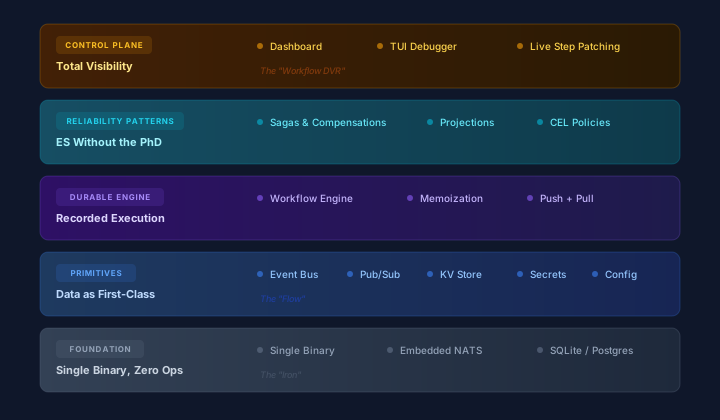
Section titled “The Ironflow Stack”Ironflow is built as a series of integrated layers, moving from the hardware-ready foundation to the high-visibility control plane.
Foundation (The “Iron”)
Section titled “Foundation (The “Iron”)”Ironflow ships as a single binary — one binary, one platform, everything derived. It contains the server, message broker (NATS), database (SQLite/Postgres), and dashboard. By embedding NATS JetStream, Ironflow provides industrial-grade messaging and persistence without the JVM/Zookeeper overhead of Kafka or the operational complexity of Redis. One command — ironflow serve — and you’re running.
Primitives (The “Flow”)
Section titled “Primitives (The “Flow”)”Ironflow replaces several pieces of infrastructure with built-in, high-performance data primitives.
- Events & Pub/Sub: Emit events from anywhere. Subscribers receive events in real time with pattern matching (
order.>), consumer groups, and durable replay. - KV Store: General-purpose key-value storage with namespaced buckets, revision tracking, and atomic operations (CAS).
- Config & Secrets: Environment-scoped configuration and AES-256-GCM encrypted secrets, write-only through the API and decrypted only at runtime.
Durable Engine
Section titled “Durable Engine”The heart of Ironflow is a workflow engine designed for recorded execution — every step captured, replayable, rewindable.
- Memoized Steps: Define functions with atomic
steps. Each step is automatically memoized; if a workflow crashes, it resumes from the last completed step instead of starting over. - Push + Pull Execution: Run short tasks via Push mode (HTTP POST to serverless endpoints) or long-running, high-throughput jobs via Pull mode (gRPC streams to dedicated workers) from the same codebase.
Reliability Patterns
Section titled “Reliability Patterns”Ironflow provides native support for the “hard parts” of distributed systems through simple, readable code.
- Sagas (Compensations): Register rollback handlers with
step.compensate. If a later step fails, compensations run automatically in reverse order. - Event Sourcing: Store domain events in the continuous history log — your system’s single source of truth. Build derived views (projections) — state computed from history that updates automatically as events arrive.
- CEL Policies: Fine-grained, high-performance authorization using the Common Expression Language (CEL) to control access to functions, streams, and secrets. Layered with built-in RBAC (system roles authoritative for allow; tenant-edited CEL is subtractive deny-only).
Control Plane (The “Workflow DVR”)
Section titled “Control Plane (The “Workflow DVR”)”The top of the stack provides total visibility into your backend, turning production runs into something you can navigate and fix.
- History Navigation (time-travel debugging): Rewind execution to any moment, inspect state at any step boundary, and scrub through the execution timeline.
- TUI Debugger: Use
ironflow inspect <run_id>for a terminal-first debugging experience with VS Code DAP support. - History Correction (live step patching): Edit a failed step’s output and resume the workflow immediately — no redeploy required. The audit trail was always there. See also History Editing (scoped injection) for pausing running workflows at step boundaries to inspect and inject data.
Next Steps
Section titled “Next Steps”| Where to go | What you’ll learn |
|---|---|
| Getting Started | Emit events, build a projection, and time-travel debug — in 5 minutes |
| Workflow Guide | Functions, steps, memoization, sagas, invoke, error handling |
| Events & Pub/Sub | Event subscriptions, consumer groups, real-time streaming |
| Event Sourcing | Entity streams, projections, event versioning |
| Architecture | Deep dive into the technical architecture |
| Platform Comparison | How Ironflow compares to Temporal, Inngest, Restate, Kurrent, and Kafka |