Entity Streams
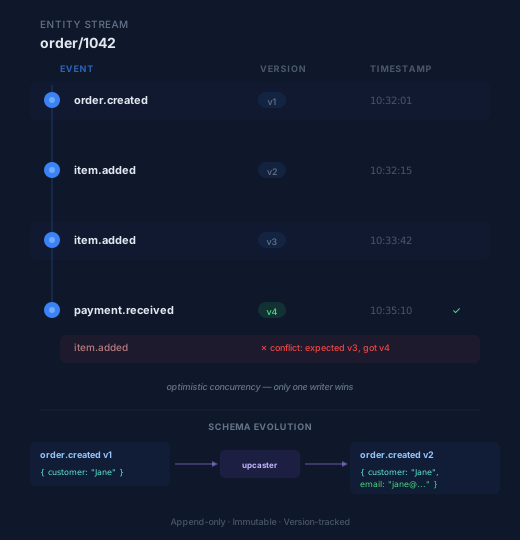
An Entity Stream is an ordered sequence of events scoped to a specific ID (e.g., user_456). Ironflow uses these streams to maintain a “source of truth” for every change in your system.
Appending Events
Section titled “Appending Events”Appending an event is the primary way to update an entity. The stream is automatically created on the first append.
import { createClient } from "@ironflow/node";
const ironflow = createClient({ apiKey: "..." });
const { entityVersion, eventId } = await ironflow.streams.append("order-123", { entityType: "order", name: "order.placed", data: { total: 100 },});res, err := client.AppendStreamEvent(ctx, "order-123", ironflow.AppendEventInput{ EntityType: "order", Name: "order.placed", Data: map[string]any{"total": 100},})from ironflow import IronflowRPCfrom ironflow.rpc.v1 import AppendEventRequest, ReadStreamRequest, GetStreamInfoRequestfrom protobuf.wkt import Struct
client = IronflowRPC(server_url="http://localhost:9123", api_key="ifkey_...")res = client.streams.append_event(AppendEventRequest( entity_id="order-123", entity_type="order", event_name="order.placed", data=Struct.from_python({"total": 100}), expected_version=-1,))print(res.entity_version, res.event_id)See the Python SDK reference for the generated Connect request and response types.
An entity ID is at most 128 characters from A-Z a-z 0-9 - . _ : ~, with no leading, trailing or doubled .. An entity type is at most 64 characters from A-Z a-z 0-9 - _ : ~, so it cannot hold a .. Either one fails with invalid_argument when it breaks the rule. An ID that starts with ironflow: (in any case) is reserved and fails with permission_denied. See Reserved names.
Optimistic Concurrency
Section titled “Optimistic Concurrency”To prevent “lost updates” when multiple workers try to update the same entity, use the expectedVersion option.
| Value | Behavior |
|---|---|
0 | Create Only: Succeeds only if the stream doesn’t exist yet. |
N | Exact Version: Succeeds only if the current version is exactly N. |
-1 | No Guard: Append regardless of version (default in the Node and Go SDKs). |
The generated Python request leaves an unset expected_version at 0, which means create only. Pass expected_version=-1 to skip the guard.
import { ContendedError } from "@ironflow/node";
// Fetch current version (returns null if the stream has no events yet)const info = await ironflow.streams.getInfo("order-123");const version = info?.version ?? 0;
// Try to append with a guardtry {  await ironflow.streams.append("order-123", { ... }, {    expectedVersion: version  });} catch (err) {  // If another write happened first, the server answers with ConnectRPC code  // `aborted` and writes nothing. The SDK throws ContendedError for it.  if (err instanceof ContendedError) {    // re-read, rebuild, retry  } else {    throw err;  }}
// Fetch current version. A stream with no events yet returns a "stream not found"// error: use version 0 for it instead of returning.info, err := client.GetStreamInfo(ctx, "order-123")if err != nil { return err}
// Try to append with a guard_, err = client.AppendStreamEvent(ctx, "order-123", ironflow.AppendEventInput{ EntityType: "order", Name: "order.updated", Data: map[string]any{"status": "shipped"},}, ironflow.WithExpectedVersion(int64(info.Version)))if errors.Is(err, ironflow.ErrContended) { // another write happened first and nothing was written: re-read, rebuild, retry} else if err != nil { return err}from protobuf.wkt import Structfrom ironflow.rpc import IronflowRPCErrorfrom ironflow.rpc.v1 import AppendEventRequest, GetStreamInfoRequest
# Fetch current version. A stream with no events yet raises "not_found": use 0.try: version = client.streams.get_info(GetStreamInfoRequest(entity_id="order-123")).versionexcept IronflowRPCError as err: if err.code != "not_found": raise version = 0
# Try to append with a guardtry: client.streams.append_event(AppendEventRequest( entity_id="order-123", entity_type="order", event_name="order.updated", data=Struct.from_python({"status": "shipped"}), expected_version=version, ))except IronflowRPCError as err: if err.code == "aborted": # another write happened first: "version conflict" ... # re-read, rebuild, retry else: raiseDeleting a Stream
Section titled “Deleting a Stream”Deleting a stream appends a $stream.deleted tombstone at the stream’s current
version + 1, under the same optimistic-concurrency check as any other append,
and drops the stream’s snapshots. After that the stream refuses every append.
It cannot be undone. The verb requires streams:delete, which only the admin
role holds by default.
A legacy stream that holds more than one entity_type cannot be deleted this
way: appending the tombstone is rejected for the same reason any other append
to that stream is.
const { entityVersion } = await ironflow.streams.delete("order-123");// entityVersion is the tombstone's version — the stream's final version
// Also delete the events below the tombstoneawait ironflow.streams.delete("order-123", { purge: true });version, err := client.DeleteStream(ctx, "order-123", false)
// purge=true also deletes the events below the tombstoneversion, err = client.DeleteStream(ctx, "order-123", true)from ironflow.rpc.v1 import DeleteStreamRequest
res = client.streams.delete(DeleteStreamRequest(entity_id="order-123", purge=False))print(res.entity_version)ironflow stream delete order-123 # prompts firstironflow stream delete order-123 --purge --yesWhat the tombstone looks like
Section titled “What the tombstone looks like”The tombstone is an ordinary event on the stream, named $stream.deleted, with
this payload:
{ "entityId": "order-123", "deletedAt": "2026-09-21T10:15:30.123456789Z", "purge": false}Because it is a real event, it occupies the next version and shows up in
read. Any later append returns ConnectRPC code failed_precondition —
“entity stream is deleted”. createSnapshot returns the same code, so a snapshot
cannot put state back onto a stream whose history was purged.
The tombstone’s emitted_by names who deleted the stream, for example
apikey:<id> or user:<id>.
You cannot write the tombstone yourself. $ is a reserved event-name prefix:
an appendEvent whose name starts with it is rejected with invalid_argument,
whatever the name. Deleting a stream is streams:delete, which only admin
holds by default, and reserving the prefix is what keeps an ordinary
entities:append from reaching the same outcome by another door. All reserved names are listed in
Reserved names.
purge: true additionally deletes every event row below the tombstone. The
tombstone row itself stays — it is what makes the stream refuse appends, so
it can never be purged. The purge runs after the tombstone has committed, not
in the same transaction; if it fails, the error says the stream is tombstoned
and re-issuing the delete with purge: true runs the cleanup again.
Purging is the stronger choice in one more way: rows elsewhere that reference
those events (a run, an outbox row, a pending debounce fire) are removed with
them by foreign-key cascade. That is what you asked for by passing purge. The
scheduled cleanup below makes the opposite choice — it skips any event another
row still references.
Three limits on how far that cascade is allowed to reach:
- Active runs block the purge. If any run triggered by an event below the
tombstone has not reached
completed,failedorcancelled, the purge is refused withfailed_preconditionand nothing is deleted. The cascade does not check status, so without this an executing run would lose its row mid-flight. The tombstone is already in place by then, so nothing new can arrive — wait for the runs to finish and issue the purge again. - On PostgreSQL, a write in progress can block the purge. The purge does not
wait on those runs or their rows. It is refused with
abortedwhile another call holds one of them or a row of one, for example a step report in progress, a run invoked from one of them, or the lease a cancelled run still holds. Nothing is deleted. The write ends on its own, so issue the purge again. The purge can still wait on the stream’s event rows, for example for a run redaction to commit, before it answers. - Dead letters go with their events.
outbox_dead_letterrows have no foreign key, so they would otherwise outlive the events they name, and every laterironflow outbox dlq requeueagainst them would fail: requeueing re-inserts intooutbox, whoseevent_iddoes cascade. The purge deletes them in the same transaction instead.
Deleting a stream that is already deleted returns failed_precondition when
purge is false. With purge: true it re-runs the purge and returns the
existing tombstone’s version.
What still works
Section titled “What still works”Reading does. read and getInfo keep answering after a delete, so the
tombstone and whatever history survived stay visible. listStreams hides the
stream.
Two fields mark a deleted stream, and both come from the ConnectRPC surface:
the GetStreamInfo response carries deleted, true once the stream is
tombstoned, and ListStreams takes includeDeleted to show tombstoned
streams again. The Node SDK, the Go SDK and the CLI expose neither in this
release; the generated Python SDK, which mirrors the protobuf messages, has
both. The dashboard reads deleted and shows a red Deleted pill on the
stream detail page, but its stream list sends no includeDeleted, so a
tombstoned stream cannot be listed there either. Through the Node or Go SDK
today, tell a deleted stream apart by reading it and looking for
$stream.deleted as its last event.
A delete also publishes system.stream.{entity_id}.deleted, carrying
entity_id, entity_type, entity_version, purge and timestamp, and
writes an entity_stream.deleted audit row.
Projections are not rewritten
Section titled “Projections are not rewritten”Scheduled cleanup
Section titled “Scheduled cleanup”Deleting a stream without purge leaves its events in place. Set
IRONFLOW_ENTITY_EVENT_RETENTION_DAYS to have the nightly job remove them
later: it only touches events below a tombstone, on streams that carry one, older
than the window, and never one that a run, outbox row, pending debounce fire or
outbox dead letter still references. A live stream is never pruned. See
configuration. The window is
server-wide, not per environment.
Redacting an Event’s Payload
Section titled “Redacting an Event’s Payload”Deleting a stream removes events. Redacting one keeps the event and removes
only its payload, replacing data with a placeholder. The row keeps its
id, name, sequence and entity version, so replay ordering and optimistic
concurrency are unaffected — the stream still has the same number of events at
the same versions, and a reducer still receives one at that position. It cannot
be undone. The verb requires events:redact, which only the admin role holds
by default.
await ironflow.redactEvent("ev_01JD2KQ7X8Y9Z");err := client.RedactEvent(ctx, "ev_01JD2KQ7X8Y9Z")from ironflow.rpc.v1 import RedactEventRequest
client.events.redact(RedactEventRequest(event_id="ev_01JD2KQ7X8Y9Z"))ironflow event redact ev_01JD2KQ7X8Y9Z # prompts firstironflow event redact ev_01JD2KQ7X8Y9Z --yesWhat the reducer sees
Section titled “What the reducer sees”{ "$redacted": true, "sha256": "9f86d081884c7d659a2feaa0c55ad015a3bf4f1b2b0b822cd15d6c15b0f00a08", "redactedAt": "2026-09-21T10:15:30.123456789Z"}sha256 is of the original bytes; nothing recovers them from it. Reducers and
upcasters receive this in the payload’s place, so a reducer that assumes its
own shape will read undefined fields rather than crash — but it will also
silently fold a missing value into state. Check first:
import { isRedacted } from "@ironflow/node";
function reduce(state, event) {  if (isRedacted(event.data)) return state; // keep what we had  return { ...state, email: event.data.email };}
The Go SDK exposes ironflow.IsRedacted(data) and the predicate is the same
everywhere: the payload is an object carrying "$redacted": true.
Snapshots are dropped
Section titled “Snapshots are dropped”A snapshot holds state derived from the bytes being removed, so leaving it
in place would keep getSnapshot serving the original content and a reducer
resuming from a snapshot would never see the placeholder. Redacting an event on
an entity stream therefore deletes every snapshot for that stream in the same
transaction, and sweeps their object-storage prefix. The next read re-reduces
from the events. Take a fresh snapshot afterwards if the stream is long enough
to need one.
What redaction does not reach
Section titled “What redaction does not reach”- Projection state. A projection’s read model is yours and Ironflow never rewrites it — on a stream delete or on a redaction. A projection that folded the removed payload into its state keeps it until you rebuild the projection or handle the removal in your own reducer.
- The runs the event triggered. A run’s
inputholds a copy of the payload, and so does itsrun.createdaudit row. Redact those withironflow run redact(orclient.redactRun).audit_eventscarries no event id, so redacting an event scrubs no audit rows at all. - A copy already published to a stream, which survives until its own retention window expires — seven days on PUBSUB; EVENTS has no age expiry and requires terminal reclamation. The worker reads each row just before it publishes. A publish past that read when the redaction commits counts as published. Any other unpublished event publishes the placeholder.
- An object-storage copy whose cleanup fails. Snapshot blobs are swept on a best-effort basis after the rows are scrubbed; a failed sweep is logged and the object is left behind with nothing to reclaim it.
Redaction is idempotent: a second call succeeds and leaves the first sha256
alone. It emits an event.redacted audit row carrying the event id only, and
publishes no system.* frame. See
ADR 0092.
Reading Stream History
Section titled “Reading Stream History”You can read the history of an entity to reconstruct its state. A read returns every event when you pass no limit. To read a long stream in pages, pass limit and a start version.
// Forward (oldest first)const { events } = await ironflow.streams.read("order-123", {  direction: "forward",  limit: 50,});
// Backward (latest first)const { events: latest } = await ironflow.streams.read("order-123", { direction: "backward", limit: 1,});events, err := client.ReadStream(ctx, "order-123", ironflow.ReadStreamOpts{ Direction: "forward",})# Forward (oldest first)page = client.streams.read_stream(ReadStreamRequest(entity_id="order-123", direction="forward", limit=50))for event in page.events: print(event.name, event.data.to_python() if event.data else None)
# Backward (latest first)latest = client.streams.read_stream(ReadStreamRequest(entity_id="order-123", direction="backward", limit=1))
# Current version, for the optimistic-concurrency guard aboveinfo = client.streams.get_info(GetStreamInfoRequest(entity_id="order-123"))print(info.version, info.event_count)Real-Time Subscriptions
Section titled “Real-Time Subscriptions”You can subscribe to an entity stream to receive live updates as new events are appended.
import { ironflow } from "@ironflow/browser";
const sub = await ironflow.streams.subscribe("order-123", {  entityType: "order",  onEvent: (e) => console.log(`New event: ${e.name}`),  replay: 10, // Replay last 10 events before going live});
from ironflow.rpc.v1 import SubscribeOptions, SubscribeRequest
# Entity events use the pattern entity:{type}.{id}.{event_name}for e in client.pubsub.subscribe(SubscribeRequest( pattern="entity:order.order-123.>", options=SubscribeOptions(replay=10), # Replay last 10 events before going live)): print(f"New event: {e.topic}")