Event Versioning
As your system evolves, event schemas change. Ironflow supports event versioning with upcaster functions that automatically transform old events to the latest schema when they’re consumed.
How It Works
Section titled “How It Works”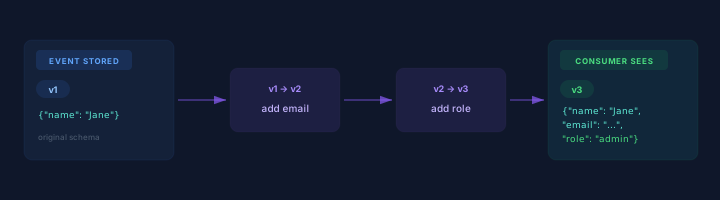
Events are stored with their original version. When a consumer reads them, upcasters transform the data through each version step until it reaches the latest schema.
Three language-specific rules to keep in mind:
- TypeScript — each
defineEvent({ version: N, upcast })registers theN-1 → Nstep. You do not specify the source version; it’s implicit. - Go —
upcasters.Register(name, from, to, fn)is explicit, buttomust equalfrom + 1. The chain walks one step at a time; a registered1 → 3hop is unreachable. - Python —
UpcasterRegistry.register(name, from_version, to_version, fn)is explicit like Go, but a hop can skip versions: the chain jumps straight to the registeredto_version(Node semantics). A redacted payload passes through unchanged, and a broken chain fails the job as non-retryable — unlike Go, which silently passes the old data through instead.
Defining Versioned Events
Section titled “Defining Versioned Events”import { defineEvent } from "@ironflow/core";
// Version 1 — original schemaconst userCreatedV1 = defineEvent({ name: "user.created", version: 1,});
// Version 2 — added email fieldconst userCreatedV2 = defineEvent({ name: "user.created", version: 2, upcast: (v1Data) => ({ ...v1Data, email: v1Data.email ?? "unknown@example.com", }),});
// Version 3 — added role fieldconst userCreatedV3 = defineEvent({ name: "user.created", version: 3, upcast: (v2Data) => ({ ...v2Data, role: v2Data.role ?? "member", }),});import ( "encoding/json" "github.com/sahina/ironflow-go/ironflow")
upcasters := ironflow.NewUpcasterRegistry()
// v1 → v2: add email fieldupcasters.Register("user.created", 1, 2, func(data json.RawMessage) (json.RawMessage, error) { var m map[string]any if err := json.Unmarshal(data, &m); err != nil { return nil, err } if _, ok := m["email"]; !ok { m["email"] = "unknown@example.com" } return json.Marshal(m)})
// v2 → v3: add role fieldupcasters.Register("user.created", 2, 3, func(data json.RawMessage) (json.RawMessage, error) { var m map[string]any if err := json.Unmarshal(data, &m); err != nil { return nil, err } if _, ok := m["role"]; !ok { m["role"] = "member" } return json.Marshal(m)})from ironflow import UpcasterRegistry
upcasters = UpcasterRegistry()
# v1 → v2: add email fieldupcasters.register("user.created", 1, 2, lambda d: {**d, "email": d.get("email", "unknown@example.com")})
# v2 → v3: add role fieldupcasters.register("user.created", 2, 3, lambda d: {**d, "role": d.get("role", "member")})Unlike Go, a Python register(name, from_version, to_version, fn) call can
jump more than one version — to_version need not equal from_version + 1.
Registering Events
Section titled “Registering Events”Register event definitions when setting up your serve handler or worker:
import { defineEvent, createEventDefinitionRegistry } from "@ironflow/core";import { serve, createFunction } from "@ironflow/node";
const userCreatedV1 = defineEvent({ name: "user.created", version: 1 });const userCreatedV2 = defineEvent({  name: "user.created",  version: 2,  upcast: (data) => ({ ...data, email: data.email ?? "unknown@example.com" }),});
const registry = createEventDefinitionRegistry();registry.register(userCreatedV1);registry.register(userCreatedV2);
const handleUser = createFunction(  {    id: "handle-user",    triggers: [{ event: "user.created" }],  },  async ({ event }) => {    // event.data is always v2 shape — upcasted automatically    console.log(event.data.email); // always present  },);
export default serve({  functions: [handleUser],  eventDefinitions: registry,});
upcasters := ironflow.NewUpcasterRegistry()upcasters.Register("user.created", 1, 2, func(data json.RawMessage) (json.RawMessage, error) { var m map[string]any if err := json.Unmarshal(data, &m); err != nil { return nil, err } m["email"] = "unknown@example.com" return json.Marshal(m)})
// Pass upcasters to Serve or NewWorkerhandler := ironflow.Serve(ironflow.ServeConfig{ Functions: []ironflow.Function{HandleUser}, Upcasters: upcasters,})from ironflow import UpcasterRegistryfrom ironflow.worker import Worker
upcasters = UpcasterRegistry()upcasters.register("user.created", 1, 2, lambda d: {**d, "email": d.get("email", "unknown@example.com")})
worker = Worker(functions=[handle_user], upcasters=upcasters)worker.run()Worker and StreamingWorker both take upcasters. Projection runners do
not apply upcasters — only function handlers do.
Emitting Versioned Events
Section titled “Emitting Versioned Events”Specify the version when emitting events:
// Emit a v2 eventawait client.emit("user.created", { name: "Alice", email: "alice@example.com" }, { version: 2 },);_, err := client.Emit(ctx, "user.created", map[string]any{ "name": "Alice", "email": "alice@example.com",}, ironflow.WithEmitVersion(2))POST /ironflow.v1.IronflowService/Emit — available through rpc.events.emit — takes an optional
version since #1955. Omit
it for 1:
from protobuf.wkt import Structfrom ironflow.rpc import v1from ironflow import IronflowRPCwith IronflowRPC(server_url=client.server_url, api_key=client.api_key) as rpc: rpc.events.emit(v1.TriggerRequest(event='user.created', data=Struct.from_python({'name': 'Alice', 'email': 'alice@example.com'}), version=2))Python also versions entity-stream events, which take version in the body —
see Versioning with Entity Streams below —
and it has the full schema registry surface
through rpc.event_schemas.register, get, list, delete, list_history,
get_revision, test_upcast and check_enforcement.
Events emitted without a version default to version 1.
Versioning with Entity Streams
Section titled “Versioning with Entity Streams”Entity stream events also support versioning:
// Append a versioned event to an entity streamawait client.streams.append("user-123", { name: "user.profile_updated", data: { name: "Alice", email: "alice@example.com" }, entityType: "user",}, { expectedVersion: 2, version: 2, // event schema version});from protobuf.wkt import Structfrom ironflow import IronflowRPCfrom ironflow.rpc.v1 import AppendEventRequest
rpc = IronflowRPC(server_url="http://localhost:9123", api_key="ifkey_...")
# Append a versioned event to an entity streamrpc.streams.append_event(AppendEventRequest( entity_id="user-123", entity_type="user", event_name="user.profile_updated", data=Struct.from_python({"name": "Alice", "email": "alice@example.com"}), expected_version=2, version=2, # event schema version))When reading entity streams, events are returned with their original version. Upcasting is applied automatically inside push handlers (serve) and pull workers (createWorker) when an event triggers a function — not on the raw read path. Calling client.streams.read(...) returns event data as it was stored; if you need the latest schema there, run it through your registered upcasters yourself.
Best Practices
Section titled “Best Practices”Always add, never remove
Section titled “Always add, never remove”Add new fields with defaults. Never remove or rename fields in a new version — consumers on older code versions may still expect them.
// Good: add field with defaultconst v2 = defineEvent({  name: "order.created",  version: 2,  upcast: (data) => ({ ...data, currency: data.currency ?? "USD" }),});
// Bad: remove field (breaks older consumers)// upcast: (data) => { delete data.oldField; return data; }
# Good: add field with defaultupcasters.register("order.created", 1, 2, lambda d: {**d, "currency": d.get("currency", "USD")})
# Bad: remove field (breaks older consumers)# upcasters.register("order.created", 1, 2, lambda d: {k: v for k, v in d.items() if k != "old_field"})One change per version
Section titled “One change per version”Keep each version bump focused on a single schema change. This makes the upcaster chain easier to understand and debug.
Version numbers are linear
Section titled “Version numbers are linear”Use simple incrementing integers (1, 2, 3). The upcaster chain runs sequentially from the stored version to the latest registered version.
Test your upcasters
Section titled “Test your upcasters”// Verify the full chain worksconst v1Data = { name: "Alice" };// After v1→v2: { name: "Alice", email: "unknown@example.com" }// After v2→v3: { name: "Alice", email: "unknown@example.com", role: "member" }# Verify the full chain worksassert upcasters.upcast_to_latest("user.created", {"name": "Alice"}, 1) == { "name": "Alice", "email": "unknown@example.com", "role": "member",}Event Schema Registry
Section titled “Event Schema Registry”Ironflow provides a server-side schema registry for storing JSON Schema definitions per event type and version. This enables schema validation, documentation, and discovery.
Registering Schemas
Section titled “Registering Schemas”# Register a schema for order.created v1curl -X POST http://localhost:9123/ironflow.v1.EventSchemaService/RegisterSchema \ -H "Content-Type: application/json" \ -d '{ "event_name": "order.created", "version": 1, "schema_json": "{\"type\":\"object\",\"properties\":{\"orderId\":{\"type\":\"string\"},\"total\":{\"type\":\"number\"}},\"required\":[\"orderId\",\"total\"]}", "description": "Order creation event" }'You can also manage schemas with the CLI: ironflow event schema register|list|get|delete|check|history. The ListSchemaHistory and GetSchemaRevision RPCs (ironflow event schema history) return archived definitions captured before a replacement or deletion. History is per event name and version. The SDKs wrap both RPCs: Schemas().ListHistory and GetRevision in Go, schemas.listHistory and getRevision in Node and the browser, and rpc.event_schemas.list_history and get_revision in Python.
Querying Schemas
Section titled “Querying Schemas”# List schemascurl -X POST http://localhost:9123/ironflow.v1.EventSchemaService/ListSchemas \ -H "Content-Type: application/json" -d '{}'
# Filter by event namecurl -X POST http://localhost:9123/ironflow.v1.EventSchemaService/ListSchemas \ -H "Content-Type: application/json" -d '{"eventName":"order.created"}'
# Read the latest versioncurl -X POST http://localhost:9123/ironflow.v1.EventSchemaService/GetSchema \ -H "Content-Type: application/json" -d '{"eventName":"order.created"}'
# Read a specific versioncurl -X POST http://localhost:9123/ironflow.v1.EventSchemaService/GetSchema \ -H "Content-Type: application/json" -d '{"eventName":"order.created","version":1}'Deleting a Schema
Section titled “Deleting a Schema”Both the event name and the version are required:
curl -X POST http://localhost:9123/ironflow.v1.EventSchemaService/DeleteSchema \ -H "Content-Type: application/json" -d '{"eventName":"order.created","version":1}'Testing Upcasts
Section titled “Testing Upcasts”Test the upcaster chain for an event without processing real data:
curl -X POST http://localhost:9123/ironflow.v1.EventSchemaService/TestUpcast \ -H "Content-Type: application/json" \ -d '{ "event_name": "order.created", "from_version": 1, "to_version": 3, "data": {"orderId": "123"} }'This returns the version chain (stepsApplied) and the input data unchanged. The server does not transform the data: upcasters are SDK code, and they run in your workers when an event is read. To test the transformation itself, call your upcaster in a unit test.
The span is capped at 200 versions: each step in the chain costs one schema lookup, so to_version - from_version greater than 200 is refused with 400.
Checking what enforcement covers
Section titled “Checking what enforcement covers”CheckEnforcement reports the server’s current enforcement mode alongside,
per registered schema, whether enforcement is actually active for it — so you
can see what switching the mode on would and would not catch before you switch
it:
# Every registered schema in the environmentcurl -X POST http://localhost:9123/ironflow.v1.EventSchemaService/CheckEnforcement \  -H "Content-Type: application/json" -d '{}'
# One event name, over a 72-hour traffic samplecurl -X POST http://localhost:9123/ironflow.v1.EventSchemaService/CheckEnforcement \  -H "Content-Type: application/json" \  -d '{"eventName":"order.created","trafficWindowHours":72}'
trafficWindowHours defaults to 24. The response carries the total count of
matching schemas separately from the returned list, so a report truncated by
the per-request cap is visible rather than silent — narrow with eventName
when it is.