What happens to a job when its worker shuts down?
Your deploy sends SIGTERM to an old worker. One job is halfway through its
handler. Another assignment is already on its way. Killing the process would
leave both jobs waiting for recovery, even though the second handler never
started.
Ironflow’s Go and Node streaming workers can drain instead. They keep the connection open to report active work, refuse assignments they cannot start, and stop when the drain deadline arrives. A refusal returns work to the queue without spending a run attempt.
Let’s follow those two jobs through a rolling deploy. The replacement worker is connected and ready before the old worker receives its signal.
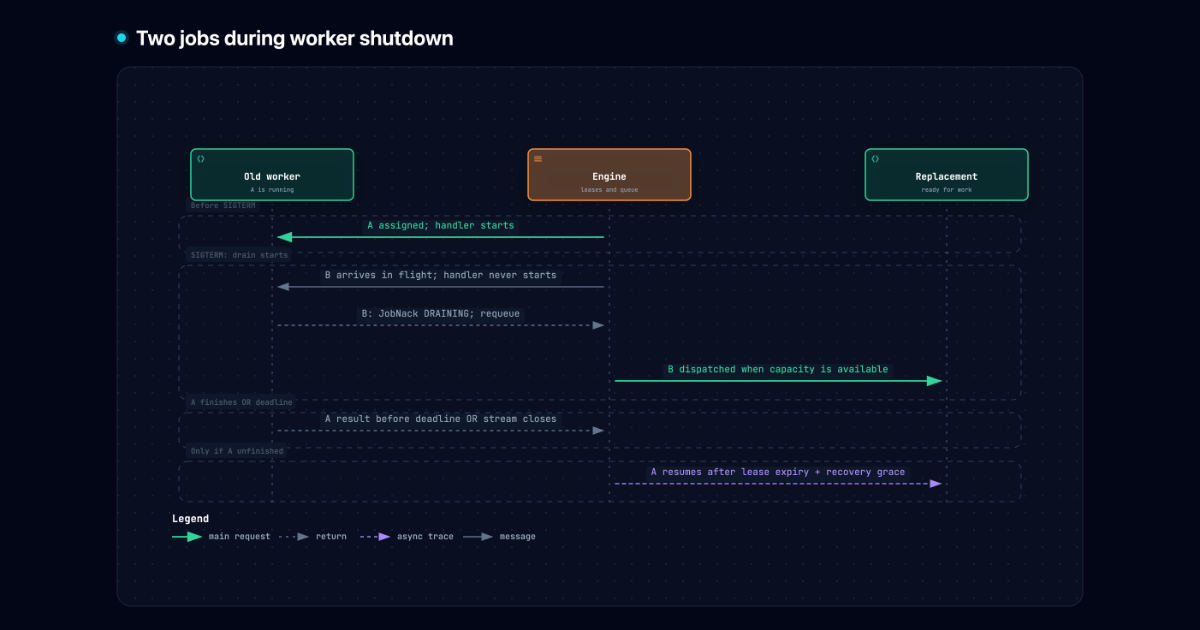
Read from top to bottom. A and B overlap; the timeline is not to scale. A’s completion and deadline recovery are alternative outcomes.
Job A is already running
Section titled “Job A is already running”The old worker accepted job A and started its handler. Five seconds into a
15-second operation, the deploy sends SIGTERM.
The worker enters draining. It stops accepting new jobs, but job A gets time
to finish. Heartbeats and result messages still use the open stream. If A
finishes within the deadline, the worker sends its result, flushes queued
messages, and half-closes the stream. It waits for the engine to close its side
before stopping, within that same deadline.
The run completes normally. Shutdown did not turn a successful handler into a failure or require a new attempt.
Here is a small Node worker with a deliberately slow operation. Use Ironflow
and @ironflow/node v0.41.0 or newer, with Node.js 22 or newer. Save this as
worker.ts in a TypeScript project. If you need a scratch project:
mkdir deploy-democd deploy-demonpm init -ynpm pkg set type=modulenpm install @ironflow/node@0.41.0npm install --save-dev tsximport { setTimeout as delay } from "node:timers/promises";import { createFunction } from "@ironflow/node";import { createStreamingWorker } from "@ironflow/node/worker-streaming";
const processOrder = createFunction( { id: "deploy-demo", triggers: [{ event: "deploy.demo" }], }, async ({ step, run, logger }) => { logger.info(`Starting run ${run.id}`); return step.run("process-order", async () => { await delay(15_000); return { processed: true }; }); },);
const worker = createStreamingWorker({ serverUrl: "http://localhost:9123", apiKey: process.env.IRONFLOW_API_KEY, functions: [processOrder], maxConcurrentJobs: 1, drainTimeout: 30_000,});
await worker.start();Run ironflow serve --dev in one terminal. This local engine does not require
an API key. In the project’s terminal, start the worker:
npx tsx worker.tsAfter registration, emit an event from another terminal:
ironflow emit deploy.demo --data '{}'Press Ctrl+C in the worker terminal while the handler runs to exercise the
SIGINT drain. A deploy’s SIGTERM uses the same drain path. The timer
represents active handler work; step.sleep would yield the job back to the
engine instead of keeping this worker busy. This demonstrates A’s drain.
B’s refusal is an in-flight assignment race, not something every shutdown
will produce.
The SDK already handles SIGINT and SIGTERM. It drains all running workers
in the process, then exits. If your application installs its own signal
listener, it owns process exit. Let the workers finish draining before exiting.
You can also initiate a drain explicitly with await worker.drain().
worker.stop() stops immediately.
Job B arrives after the drain starts
Section titled “Job B arrives after the drain starts”Job B was offered just as the old worker entered its drain. That race matters: the assignment can already be in flight before the dispatcher knows this worker is draining. B’s handler has not started.
The worker sends JobNack with reason DRAINING, carrying the assignment’s
execution sequence and lease token. The engine marks the session as draining,
releases B’s lease and capacity slot, and moves its run from running to
waiting. It queues a new execution sequence with no recovery grace period.
The replacement worker can pick it up as capacity becomes available.
An assignment can put a run in running before the SDK starts its handler.
Seeing B briefly enter that state does not mean B’s handler executed. The new
sequence fences late messages from the refused assignment.
If the old worker were full rather than draining, it would send AT_CAPACITY.
The engine would still requeue B, but hold back the worker’s overestimated
capacity slot until a heartbeat shows space. It does not immediately send B
back into that same full slot. This handles cases such as reconnects where the
engine’s available credits exceed the worker’s actual free slots.
Refusal is different from failure
Section titled “Refusal is different from failure”| What happened | Retry attempt | Recovery count | What comes next |
|---|---|---|---|
B never started; the engine accepts its JobNack | Unchanged | Unchanged | Runnable again without recovery grace |
| A’s handler reports a retryable failure | Uses the retry budget | Not a lease recovery | Retry if the function’s policy allows it |
| A disappears without a terminal result | Not a handler-failure retry | Counts toward the recovery ceiling | Lease expiry, recovery grace, then redispatch |
A retryable JobFailed is the wrong way to refuse work. It spends the run’s
retry budget and can fail a run on its last allowed attempt. JobNack says
“I did not start this assignment,” so it changes neither attempt nor
recovery_count and writes no handler error.
If A outlives the deadline
Section titled “If A outlives the deadline”The Go and Node SDK drain default is 30 seconds. An engine Shutdown message
can supply its own deadline; the engine’s default is 25 seconds. The worker
uses a positive timeout from that message instead of its configured timeout.
A process signal starts the SDK’s configured drain. In Node, a drain already
in progress keeps its original deadline.
Give the process supervisor enough termination grace for the drain and exit.
SIGKILL bypasses the SDK entirely. At the drain deadline, the worker cancels
remaining jobs and closes the stream. Cancellation cannot undo an external
write, and arbitrary handler code may keep running until the process exits.
If A has no recorded terminal result, the engine recovers it through lease
expiry. Current defaults are a 90-second lease, a 30-second scanner interval,
and a 30-second recovery grace period. The lease clock starts at its last
refresh, not at SIGTERM. Scanner and dispatch scheduling add time too.
With a healthy engine and available replacement capacity, the ordinary
crash-recovery path takes roughly 90 seconds to three minutes from loss of the
worker to resumed execution, before the job’s own runtime.
Making B runnable immediately after a nack is a different path.
Lease recovery counts toward RecoveryCeiling, which permits 10 consecutive
recoveries by default. The next recovery fails the run with
EXECUTION_RECOVERY_EXHAUSTED. An accepted yield that releases the lease resets
this count. Completing a step inside a still-running job does not. A refused
job does not spend that allowance.
Completed durable steps whose results reached the engine can be reused. An external write that succeeded before its step result was recorded may happen again. Give that destination an idempotency key or a uniqueness constraint. Graceful drain and execution fencing do not make external side effects exactly once.
What to watch during the deploy
Section titled “What to watch during the deploy”The Node worker logs Draining worker... and, while A runs,
Waiting for 1 jobs to complete.... An in-flight B produces
Draining, refusing job. A capacity refusal produces At capacity, refusing job.
For an accepted nack, the engine logs
capacity: job nacked, re-queued with no attempt used, with the run ID and
reason. The run’s attempt stays the same as it moves through waiting and
back to running on the replacement worker.
If A exceeds the deadline, look for
Drain deadline reached; cancelling 1 active jobs. Lease recovery emits the
audit events capacity.lease.expired and capacity.segment.recovered.
After recovery, waiting can include the recovery grace period; it is not
proof that the replacement worker is broken. The
crash recovery explanation
shows how to inspect the leases and the queued segment’s eligibility time.
If a refusal cannot reach the engine, immediate requeue is unavailable. The streaming heartbeat refreshes leases only for reported jobs, with a compatibility fallback for older workers that omit the job list. An unreported job can therefore recover after lease expiry even while a worker stays connected. That fallback recovery does count toward the recovery ceiling.
Roll out the engine before the workers
Section titled “Roll out the engine before the workers”v0.40.0 added streaming step.invoke support.
v0.41.0 added graceful drain and JobNack.
Upgrade the engine first, then the streaming SDKs. An older engine ignores
the new nack message, so a new worker’s refusal does not get immediate
requeue. A newer engine with an older SDK can use the heartbeat backstop,
subject to the compatibility fallback. Both sides need nack support for the
refusal path described here.
When upgrading from pre-v0.40.0 streaming SDKs, update every participating Go
and Node worker. Those older SDKs can interpret a failed invoke as success
with empty output. See the
Node streaming worker reference
for protocol behavior and rollout notes, and the
API protocol reference
for the WorkerService transport. Keep a ready replacement, allow the old
worker to drain, and distinguish a refused assignment from a handler failure
when reading the runs.